- Table of Contents
Problem
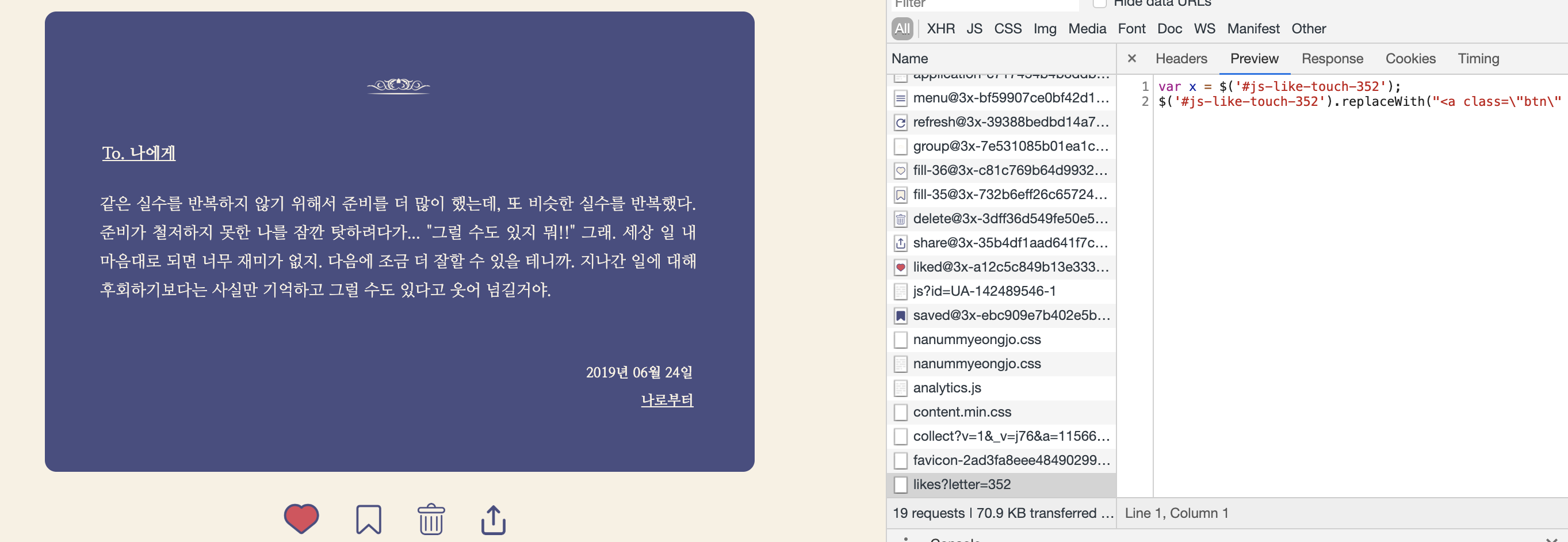
When developing features for a web service, there are times when you need to receive and handle a response from the server asynchronously. A classic example is a "like" button. The goal is to toggle a like and reflect it on the server — all without refreshing the page.
Development environment
- Ruby 2.6.3
- Rails 6.0.0.rc1
- haml + sass
Solution
- The first thing that comes to mind when you hear "asynchronous" is probably Ajax.
- This time, however, we will use Rails' built-in
remotefeature to implement the async like functionality.
likes/_buttons.html.haml
.buttons
  - if current_user.present? and letter.likes.pluck(:user_id).include?(current_user.id)
    = link_to image_tag("buttons/liked@3x.png", class: "btn-like"), likes_path(letter: letter), remote: true , method: :post , class: "btn", id: 'js-like-touch-' + letter.id.to_s, "data-turbolinks": "false"
  - else
    = link_to image_tag("buttons/fill-36@3x.png", class: "btn-like"), likes_path(letter: letter), remote: true , method: :post , class: "btn", id: 'js-like-touch-' + letter.id.to_s, "data-turbolinks": "false"
This is the partial that renders the like button. Note that it is written in HAML syntax (if you use ERB, feel free to use a converter). The key part here is remote: true. Setting remote on a link tells Rails to handle the response in place without navigating away from the page. An id is generated dynamically so we can target the correct element when handling the response later.
routes.rb
Rails.application.routes.draw do
  post '/likes', to: 'likes#create'
end
Wire the POST route to the controller.
controllers/likes_controller.rb
  def create
    unless current_user.present?
      redirect_to user_session_path
      return
    end
    liked = Like.find_by(user_id: current_user.id, letter_id: params[:letter])
    @letter = Letter.find_by(id: params[:letter])
    if liked.present?
      liked.destroy
      return
    end

    like = Like.new
    like.user_id = current_user.id
    like.letter_id = params[:letter]
    like.save
end
This is the controller action that handles the create request. If no explicit .js response is defined, Rails will automatically look for the corresponding template file for the create action. If you want to respond differently based on format, you can configure the response per |format|.
create.js.erb
$('#js-like-touch-<%= @letter.id %>').replaceWith("<%= j render partial: 'likes/button', locals: {letter: @letter} %>");
This is the JavaScript file corresponding to the create action. It runs whenever the like button is clicked. As the .erb extension suggests, Rails template helpers are available here as well. Because the link's id was pre-set to letter.id, we select the element matching the input we received and replace it. The partial already handles the conditional logic — it renders a different image depending on whether the letter has been liked — so we just need to tell it to re-render.
Conclusion
Development with RubyOnRails and Rails Templates can be a bit confusing at first because the boundary between backend and frontend is less clear than in modern separated architectures. It also crossed my mind whether depending entirely on Rails' built-in functionality instead of writing Ajax manually was over-relying on the framework. But as you can see, it is concise and powerful! No manual Ajax configuration is needed. If you need server-push functionality, Rails Action Cable covers that too. Welcome to the fast and easy world of Rails!
For more details, please refer to the Working with JavaScript in Rails guide.
(Promo) Please show lots of love to Hearim — Letters Written for Yourself!